


Blogs
Move beyond the spreadsheet. This is your definitive source for qualitative market analysis, exploring the disconnect between public narratives and market reality. We break down how to use expert insights and AI to find the alpha that quantitative models miss.
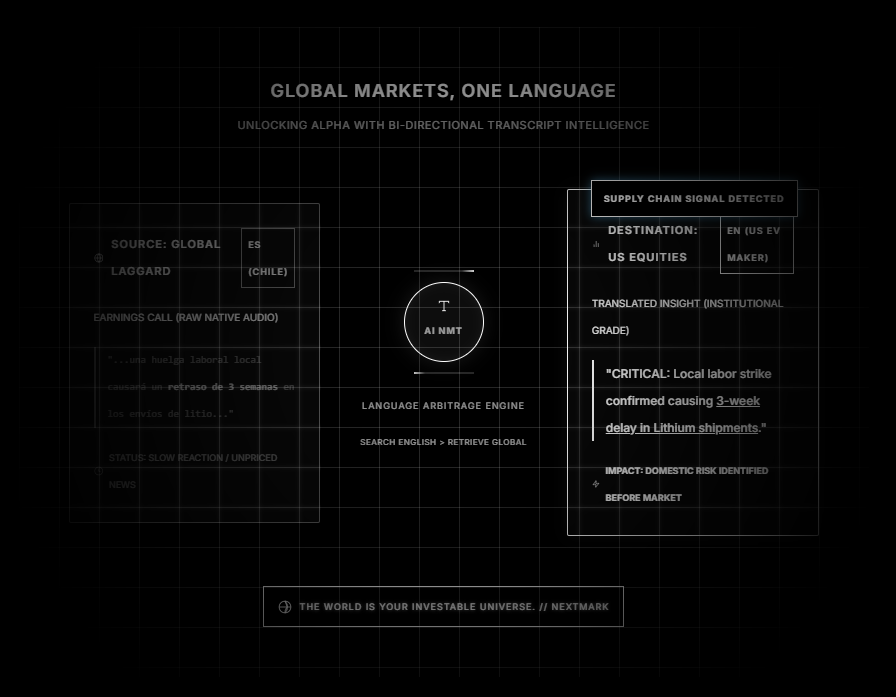
While 50,000 analysts compete over US equities, the "Language Discount" leaves vast pockets of the global market mispriced. This article demonstrates how Neural Machine Translation (NMT) unlocks a "Language Arbitrage," allowing investors to instantly access non-English transcripts from Japan to Brazil. We discuss the "Butterfly Effect" trade, where analyzing foreign supply chain commentary—such as a Chilean miner’s warning in Spanish—can predict domestic risks for US companies days before the news hits English wires.
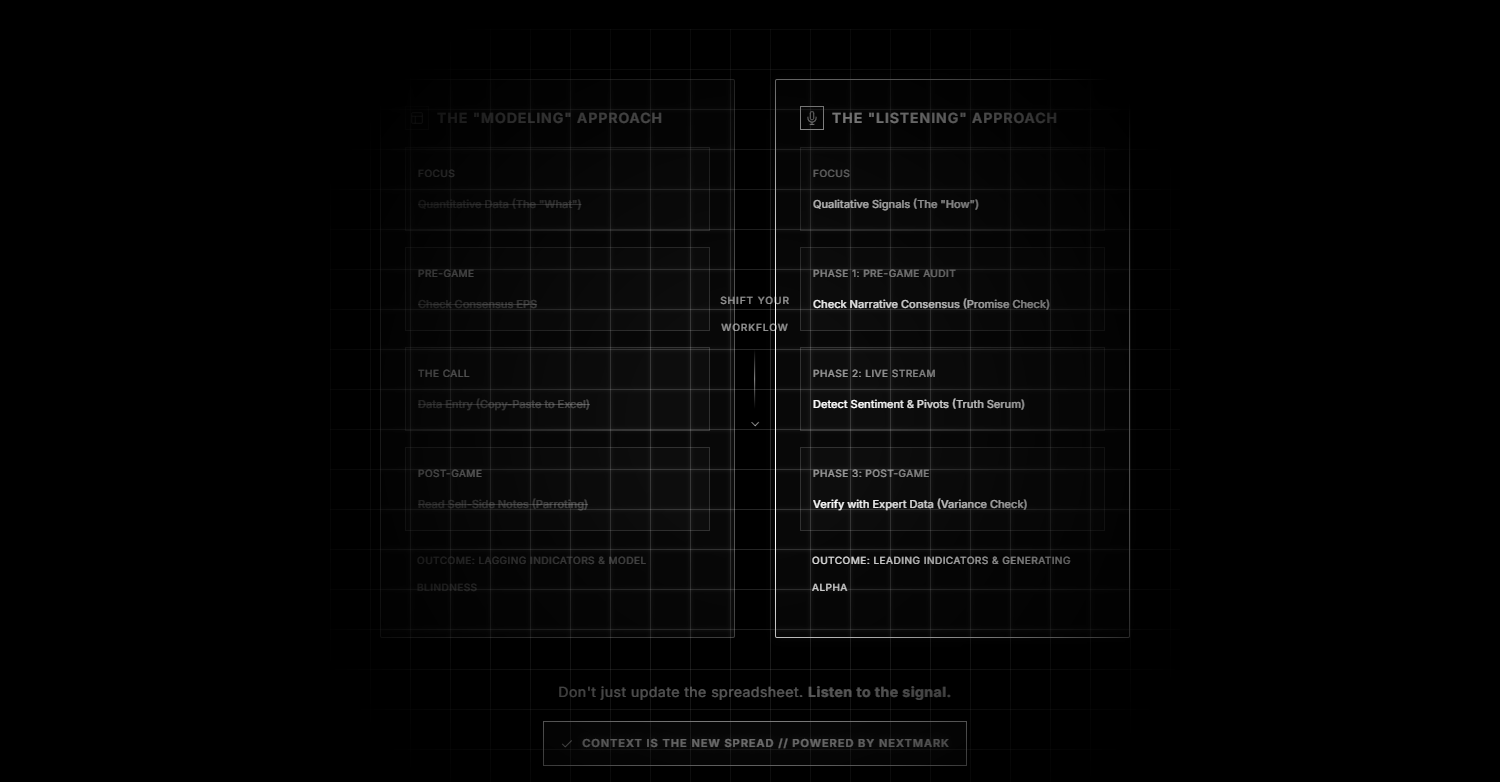
In an era of commoditized financial data, the competitive edge has shifted from spreadsheet modeling to active listening. This guide challenges the "Data Entry" approach used by most analysts, proposing a new 3-step "Listening Workflow" to detect signal amidst the noise. We outline how to audit "Narrative Consensus" before the call, monitor live sentiment during the Q&A, and verify management claims against primary expert data. Discover why the modern Alpha opportunity lies not in the math, but in the nuance of the delivery.
Latest Insights and Trends
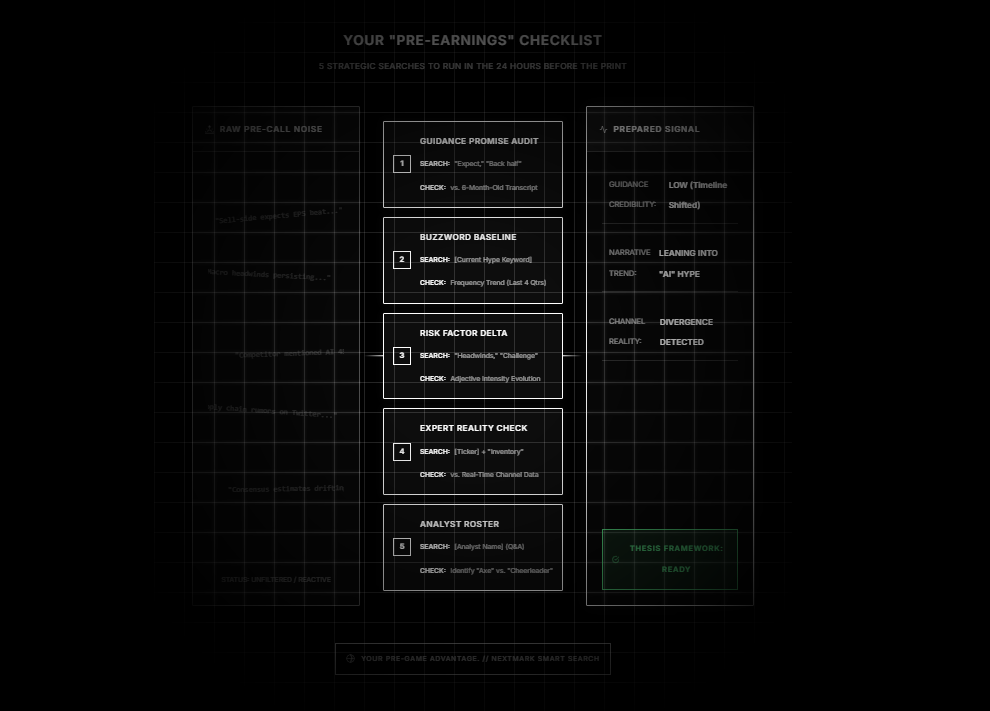
Earnings calls are high-speed events where preparation is the only edge. This post provides a definitive 5-step "Pre-Earnings Checklist" to run 24 hours before the print. We detail essential searches including the "Guidance Promise Audit" to hold management accountable, the "Buzzword Baseline" to track hype cycles, and the "Expert Reality Check" to contrast CEO optimism with supply chain ground truth. Don't just tune in; build a mental framework that separates the signal from the script.
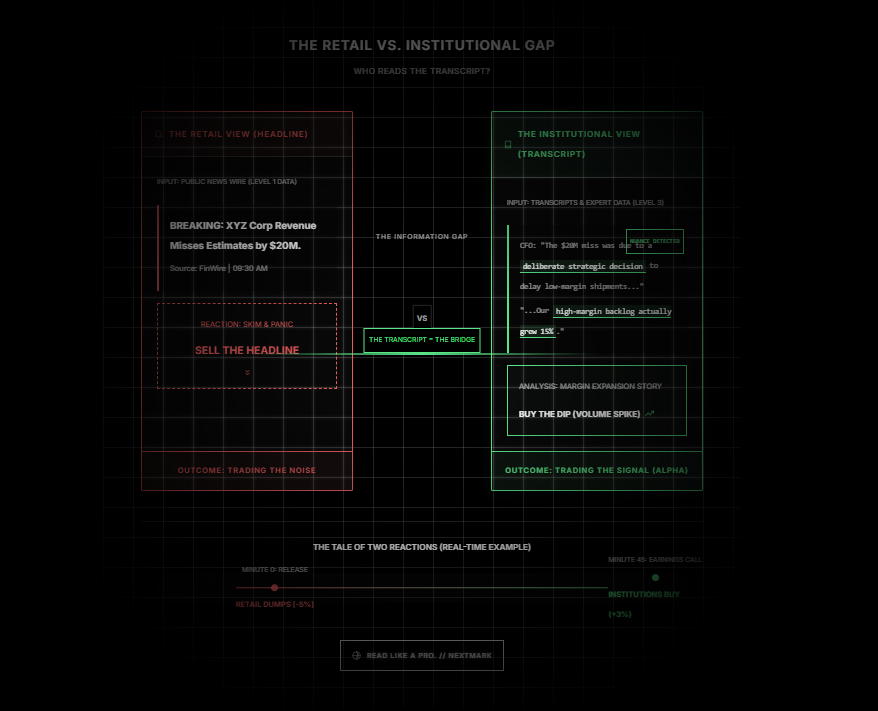
While retail traders react to headlines, institutional investors trade the transcript. This article analyzes the structural "Information Gap" that drives post-earnings volatility, explaining why stocks often dump on the news but rally on the call. We explore the difference between "Skimming" for confirmation and "Reading" for contradiction, and highlight the "Information Moat" provided by Level 3 primary expert data. Discover how to migrate your workflow from the retail notification loop to the deep-dive institutional protocol.

Corporate pivots are rarely sudden; they are "soft launched" months in advance. This guide breaks down the anatomy of "Narrative Drift," showing how management tests the waters before officially changing strategy. We identify the three phases of a pivot: the "De-emphasis" of old metrics, the "Adjective Drift" that reframes growth expectations, and the "Trojan Horse" pilot program that signals the future. Learn to visualize these trend lines to position yourself for the strategic turn before the press release hits.
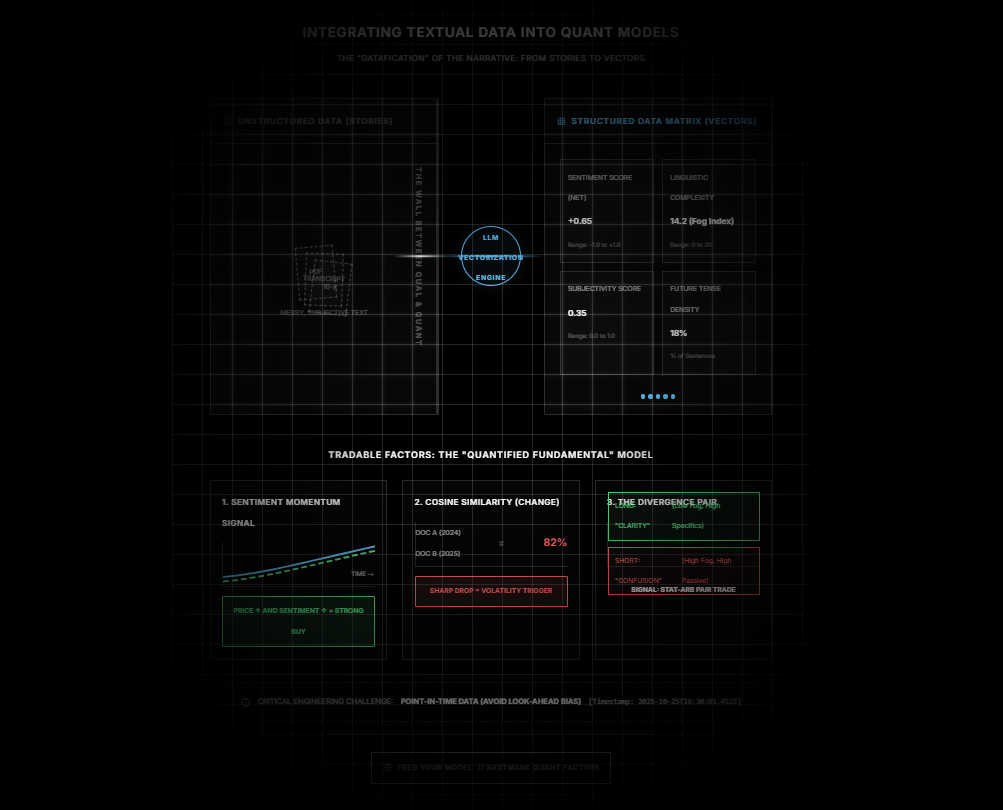
The wall between quantitative and fundamental investing has collapsed. This post explains how "Quantamental" strategies can now integrate textual data by converting unstructured language into tradable mathematical vectors. We detail three specific factors: "Sentiment Momentum" for confirming price trends, "Cosine Similarity" for measuring the stability of risk disclosures, and "Divergence" pair trades that go long on clarity and short on confusion. Discover how to backtest linguistic signals using point-in-time data to avoid look-ahead bias.

The most dangerous risks in investing are the ones management stops talking about. This article teaches you to analyze "Omission as Information," focusing on metrics that suddenly vanish from the slide deck. We explore "KPI Rotation," where failing metrics are swapped for vaguer proxies, and "Strategic Amnesia," where stalled projects are quietly dropped from the narrative. Learn to spot the "Compound Question Dodge" and the "Shrinking Q&A" as statistical indicators of a management team trying to minimize exposure to scrutiny.
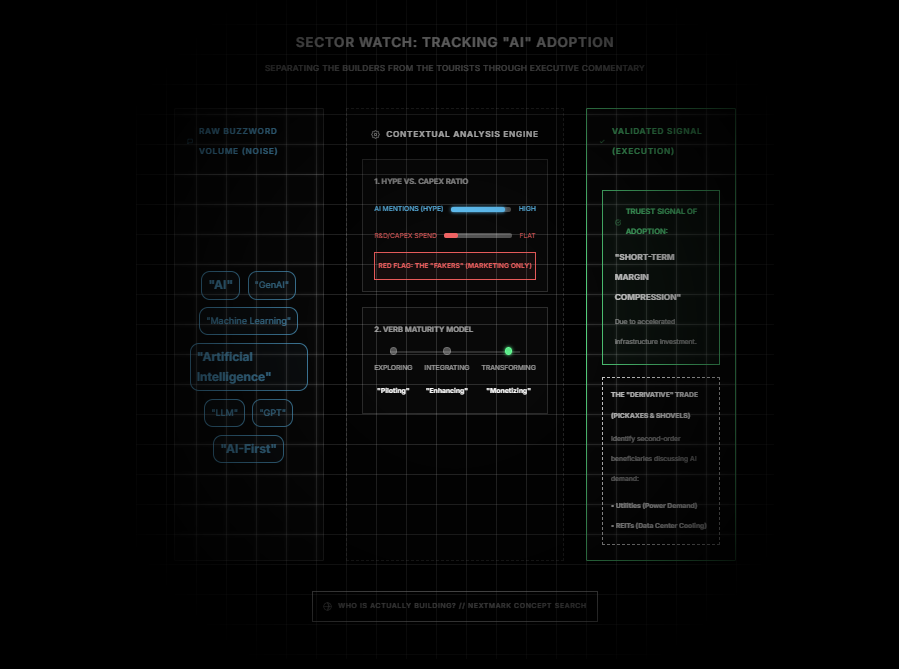
Every company claims to be an "AI Winner," creating a dangerous noise-to-signal ratio for investors. This guide provides a framework for separating the builders from the tourists using the "Hype/CapEx Ratio" to spot mismatches between mouth and wallet. We analyze the "Verb Selection" of executives—distinguishing between low-conviction "Exploring" and high-conviction "Deploying"—and expose the "Efficiency Bluff," where companies promise AI cost savings without showing the necessary operating leverage.
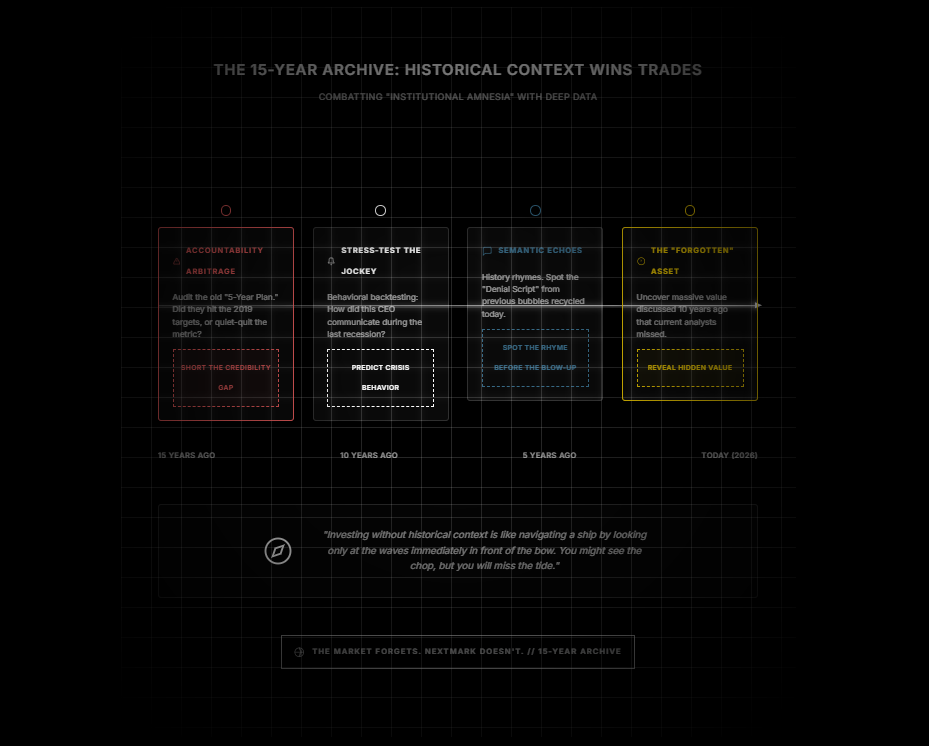
Wall Street suffers from "Institutional Amnesia," often forgetting failed promises once the news cycle turns. This post argues for the value of the "Deep Archive," urging investors to audit management behavior across a 15-year horizon. We discuss "Accountability Arbitrage"—checking if past 5-year plans were actually delivered—and "Behavioral Backtesting," which analyzes how current leadership navigated previous crises like 2008 or 2015. Discover how "Semantic Echoes" from past bubbles can warn you of impending sector blow-ups today.

"Cautiously optimistic" is often a smokescreen. This article details the science of "Tone Analysis," using linguistic metrics to mathematically differentiate between true conviction and defensive posturing. We break down the "Fog Index" (complexity as a hiding place), the "Passive Voice Trap" (deflecting ownership), and the "Specifics Ratio" (vague vs. concrete). By quantifying these patterns, investors can detect a "Confidence Downgrade" in management's language weeks before the market sees a formal guidance cut.

With watchlists generating thousands of alerts, "Alert Fatigue" is a major risk for institutional investors. This guide presents a strategy for "Smart Muting," teaching you to filter the data stream by "Content Change" rather than document type. We classify corporate data into three buckets—Static, Script, and Signal—and explain how to silence the marketing fluff of press releases while amplifying critical "Expert" data. Learn to configure concept-based filters that only trigger when the narrative actually shifts.

Most investors treat an earnings call as a single event, but smart money knows it is two: a theatrical performance and a live interrogation. We introduce the "Q&A Discount," a methodology that de-emphasizes the sanitized "Prepared Remarks" to focus exclusively on the unscripted reality of the Q&A session. Discover how to spot the "Truth Gap"—a measurable divergence in sentiment between the script and the answers—and how to identify "Non-Answer" indicators where management pivots to avoid revealing material weakness.
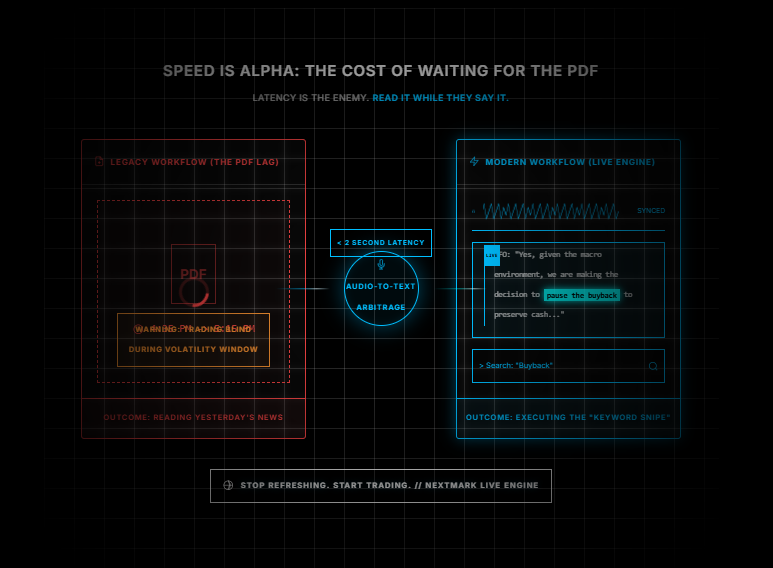
In modern markets, waiting for the official PDF transcript means reading yesterday’s news. This piece analyzes the "15-Minute Volatility Window" immediately following an earnings print, where the true price discovery happens. We explore the "Audio-to-Text Arbitrage," arguing that the ability to search and act on live, sub-second transcript streams provides a tactical execution edge over those relying on delayed documents. Learn why latency is the enemy and how preserving "emotional metadata" like silence can reveal what the text deletes.
While 50,000 analysts compete over US equities, the "Language Discount" leaves vast pockets of the global market mispriced. This article demonstrates how Neural Machine Translation (NMT) unlocks a "Language Arbitrage," allowing investors to instantly access non-English transcripts from Japan to Brazil. We discuss the "Butterfly Effect" trade, where analyzing foreign supply chain commentary—such as a Chilean miner’s warning in Spanish—can predict domestic risks for US companies days before the news hits English wires.
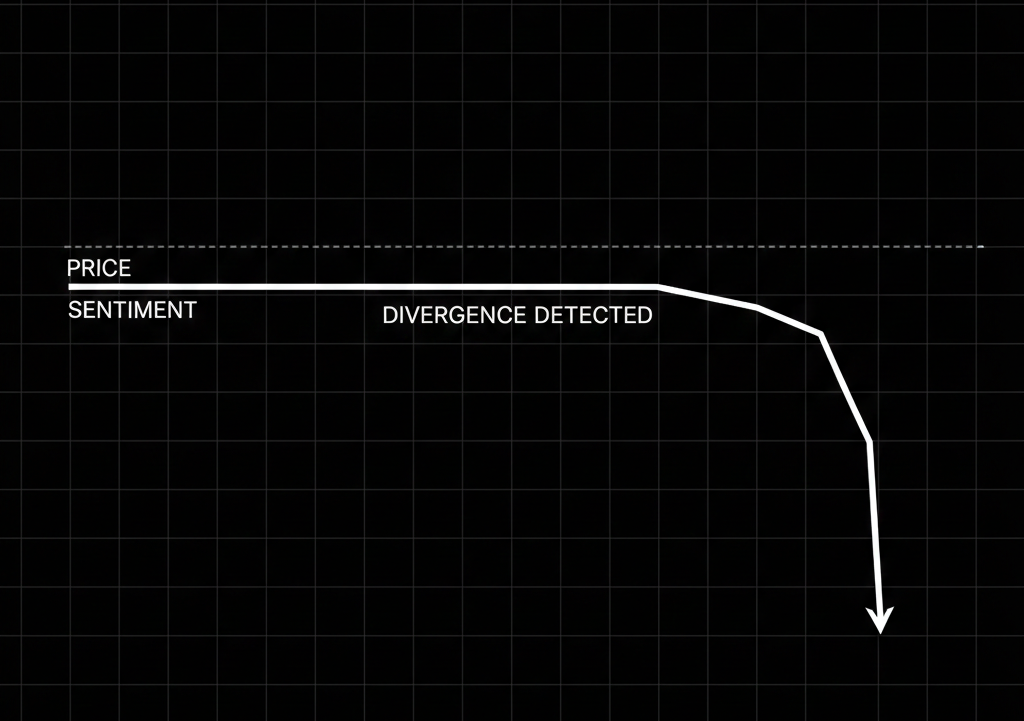
"Gut feel" is no longer a subjective art form; it is a measurable data point. This post explains how Natural Language Processing (NLP) transforms soft signals like hesitation and confidence into objective "Sentiment Scores" for your risk framework. We detail three actionable strategies: trading the "Script vs. Reality" gap between prepared remarks and the Q&A, tracking "Sentiment Momentum" over time, and using peer-relative scoring to spot sector resilience. Learn to quantify the "vibe" and validate your thesis with linguistic rigor.

For decades, "Ctrl+F" was the standard for research, but in today's carefully crafted corporate environment, keyword search is a liability. This article explores the "Synonym Gap," where rigid text searches miss critical risks like "markdowns" or "softness" because analysts fail to guess the exact corporate euphemism. We introduce the power of AI-driven "Concept Search," which matches intent rather than characters, allowing investors to perform thematic sweeps across the S&P 500 to uncover hidden cluster risks before they hit the headlines.
In an era of commoditized financial data, the competitive edge has shifted from spreadsheet modeling to active listening. This guide challenges the "Data Entry" approach used by most analysts, proposing a new 3-step "Listening Workflow" to detect signal amidst the noise. We outline how to audit "Narrative Consensus" before the call, monitor live sentiment during the Q&A, and verify management claims against primary expert data. Discover why the modern Alpha opportunity lies not in the math, but in the nuance of the delivery.
Qualitative Data Is the Edge. Start Using It.