
Management Tone Analysis: Detecting Confidence vs. Caution

“We remain cautiously optimistic.”
It is the most overused phrase in corporate finance. It sounds prudent, measured, and professional. But to a trained ear, it is often a smoke screen.
Does it mean they see a clear path to growth but want to temper expectations (Confidence)? Or does it mean they are seeing demand collapse and don't want to spook the street (Caution)?
For years, interpreting these nuances was an art form. You had to "know" the CEO. You had to read between the lines.
Today, Tone Analysis is a science. By analyzing the linguistic structure of earnings calls, we can mathematically differentiate between true conviction and defensive posturing. It turns out that confident leaders and cautious leaders speak two very different languages.
Here is how to decode the difference.
The Metric of Obfuscation: The "Fog Index"
The first rule of Tone Analysis is simple: Truth is usually simple.
When a management team has good news, they want you to understand it immediately. They use short sentences, simple words, and concrete numbers.
- Example (Confidence): "Revenue grew 20%. We gained share in all three regions."
When a management team has bad news, their instinct is to dilute it. They subconsciously increase the complexity of their speech to create distance between themselves and the problem. This is measured by the Gunning Fog Index (a test that estimates the years of education needed to understand a text).
- Example (Caution): "While we navigated a complex macroeconomic backdrop, our strategic initiatives around revenue optimization encountered some transitory headwinds related to regional absorption rates."
If the "Fog Index" of the opening remarks spikes from a Grade 10 level last quarter to a Grade 16 level this quarter, watch out. They are hiding behind the thesaurus.
The Passive Voice Trap
Confident leaders take ownership. Anxious leaders deflect it. The grammatical marker for this is the Passive Voice.
- Active Voice (Confidence): "We missed the target because we underestimated the supply constraint." (Subject -> Action).
- Passive Voice (Caution): "The target was missed due to unforeseen supply constraints that were encountered." (Action happened to the Subject).
Nextmark’s AI scans for the density of passive verbs. A sudden increase in passive voice during the Q&A section is a high-probability indicator that management feels a lack of control over the business. They are framing themselves as victims of circumstance rather than drivers of the outcome.
The "Specifics" Ratio
Confidence is specific. Caution is vague.
We track a metric called the Specifics Ratio—the density of numbers, dates, and proper nouns vs. general adjectives.
- High Specifics: "We expect margins to recover by 50 basis points in Q3 due to the new copper contracts."
- Low Specifics: "We expect margins to improve meaningfully in the back half as synergies kick in."
"Meaningfully" is not a number. "Back half" is not a date. "Synergies" is a buzzword.
When the Specifics Ratio drops, conviction is dropping. Management is asking you to trust the direction, because they aren't sure about the destination.
The "Future Tense" Shift
Finally, watch when they are talking about.
A confident management team spends the majority of the call talking about the Future (Growth, Roadmap, Guidance). A cautious management team spends the majority of the call explaining the Past (Quarterly results, legacy issues, justifications).
If the CEO spends 40 minutes dissecting the nuances of last quarter’s FX headwinds and only 5 minutes on the full-year outlook, they are looking in the rearview mirror because they are afraid of what they see through the windshield.
Quantifying the "Vibe"
You cannot catch all these linguistic slips with the naked ear—especially not across 50 companies in a week.
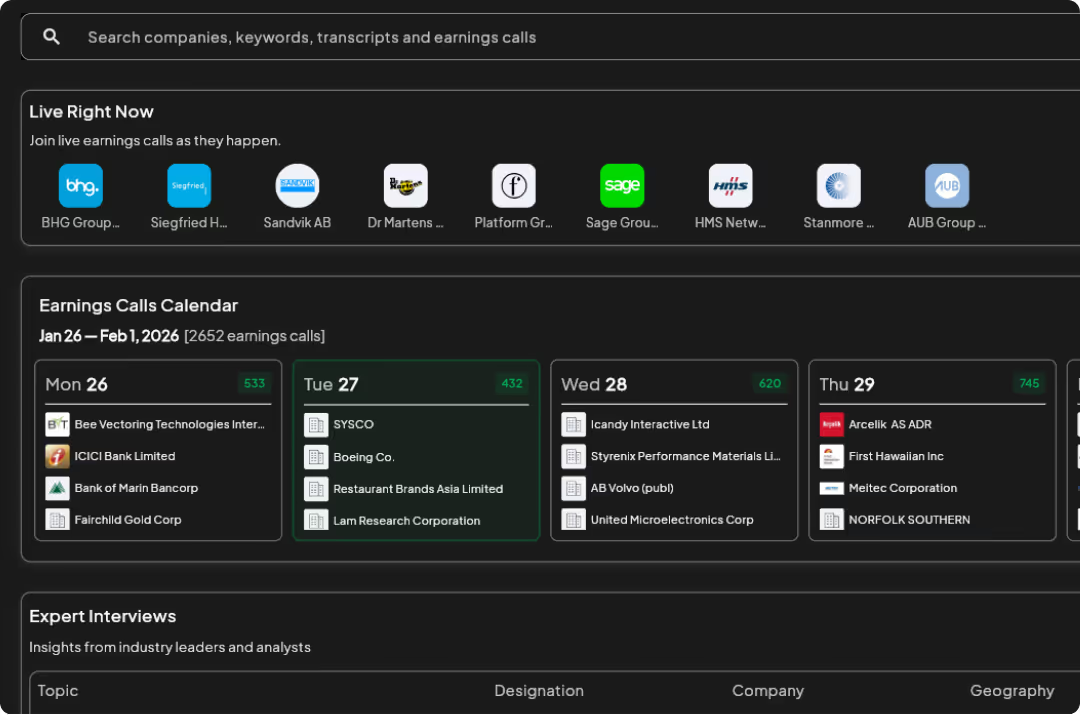
That is why we built Tone Analysis into the Nextmark core. Our engine tracks the Fog Index, Passive Voice Density, and Specifics Ratio for every call, flagging the "Tone Shift" instantly.
It stops you from being lulled to sleep by a smooth-talking CEO. It highlights the moment the language changes, so you can change your position.
Hear what they aren't saying.
Nextmark’s Tone Analysis engine quantifies linguistic complexity and confidence in real-time.
Ready to see the magic happen? Register for a demo that actually respects your time. Our specialists are standing by to hook you up with platform access or get those API feeds flowing.
Qualitative Data Is the Edge. Start Using It.