
Global Markets, One Language: Unlocking Alpha in Non-English Transcripts
If you are analyzing Apple, Microsoft, or NVIDIA, you are competing in the most crowded arena on earth.
There are over 50,000 professional analysts covering US equities. They speak the same language, they read the same news wires, and they wake up in the same time zones. In this environment, "informational efficiency" is near-perfect. The price reflects all available public information almost instantly.
But the global economy does not speak English.
Manufacturing happens in Shenzhen. Semiconductor fabrication happens in Hsinchu. Mining happens in Minas Gerais.
For decades, the language barrier acted as a moat. It kept US capital focused on US listings, leaving vast pockets of the global market under-analyzed and mispriced.
Today, that moat is gone. Advances in Neural Machine Translation (NMT) have turned the language barrier into a Language Arbitrage. Here is how to unlock Alpha in the 60% of the world that your competitors aren't reading.
The "English Premium" vs. The "Language Discount"
There is a measurable phenomenon in global finance: Companies that communicate clearly in English trade at a premium. They are accessible to the massive liquidity of Wall Street.
Conversely, incredible businesses in Japan, Brazil, or South Korea often trade at a "Language Discount."
- Their P/E ratios are lower.
- Their volatility is higher (due to lower liquidity).
- Crucially: Their reaction to news is slower.
Because fewer algorithms and analysts are scraping the native-language transcripts of a mid-cap Osaka industrial firm, new information takes longer to get priced in. For the qualitative investor, this lag is an opportunity.
The "Butterfly Effect" Trade (Supply Chain Intelligence)
You don't have to buy foreign stocks to profit from foreign data. The most powerful application of global transcripts is predicting Domestic Risk.
We live in a hyper-connected supply chain. A disruption in one country is a margin miss in another.
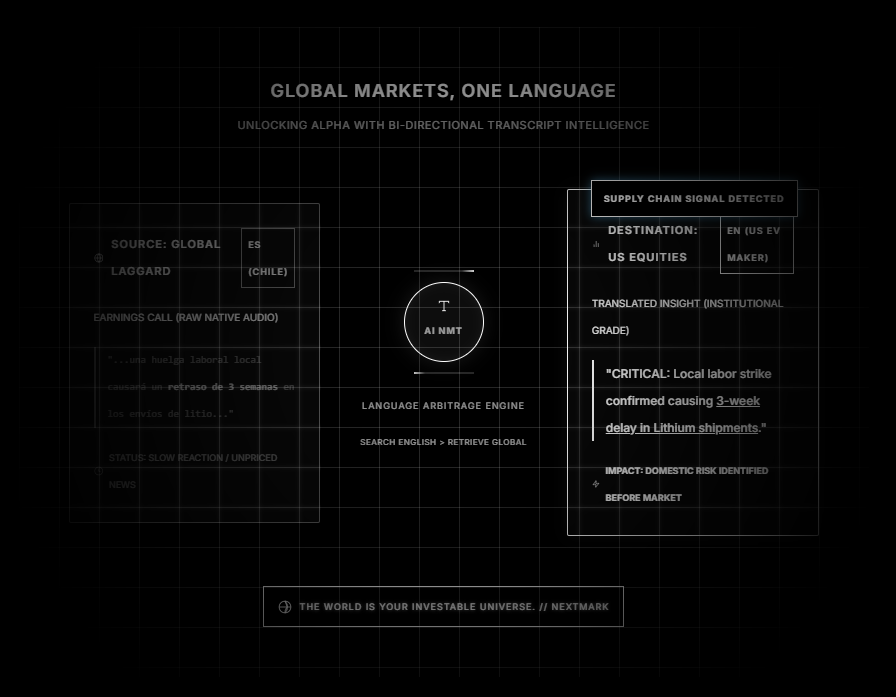
- The Scenario: You own stock in a major US Electric Vehicle manufacturer.
- The Blind Spot: You only read English news. The US CEO says "Supply chains are robust."
- The Signal: A Lithium mining executive in Chile gives an earnings call in Spanish. He warns of a 3-week delay in shipments due to local labor strikes.
If you are waiting for that news to be translated, aggregated, and published in the Wall Street Journal, you are 3 days late. The trade is over.
But if you are using real-time bi-directional translation, you see the Spanish transcript the moment it hits the wire. You see the risk to the US auto-maker’s Q3 delivery numbers before their own shareholders do.
Breaking the Barrier: Bi-Directional Intelligence
Historically, covering global markets meant building a "Foreign Desk"—hiring analysts who spoke Japanese, Portuguese, and Mandarin. It was slow and expensive.
Nextmark democratizes this capability.
Our platform treats language as a feature, not a barrier.
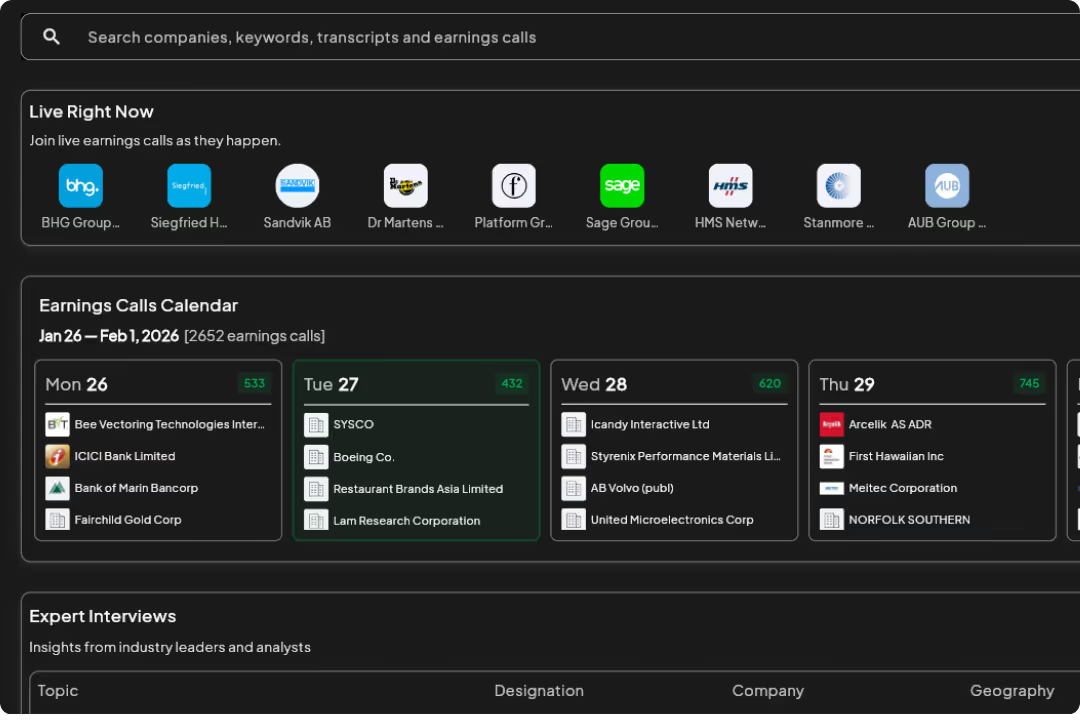
- Search in English: You type "Battery Shortage" into the search bar.
- Retrieve Globally: The AI scans transcripts in 60+ languages.
- Read Locally: It returns the relevant paragraph from that Chilean miner, translated instantly into institutional-grade English.
You are no longer limited to the "English Internet." You are searching the "Global Economy."
The Warren Buffett Lesson
In 2020, Warren Buffett shocked the market by buying massive stakes in Japan’s five largest trading houses (Sogo Shosha). Most US investors ignored them because their conglomerates were complex and their disclosures were largely in Japanese.
Buffett saw value where others saw a barrier.
The next decade of Alpha will not come from analyzing the same 500 US companies with slightly better spreadsheets. It will come from expanding your universe.
The world is full of signal. Stop ignoring the ones that don't speak your language.
The world is your investable universe.
Nextmark provides instant, bi-directional translation for earnings calls and expert transcripts in 60+ languages.
Ready to see the magic happen? Register for a demo that actually respects your time. Our specialists are standing by to hook you up with platform access or get those API feeds flowing.
Qualitative Data Is the Edge. Start Using It.