
The "Silent" Warning: What Management Doesn't Say

In the famous Sherlock Holmes story Silver Blaze, the detective solves the case not by finding a clue, but by noticing a non-event: the dog didn't bark in the night. This implied the intruder was someone the dog knew.
Financial markets are noisy. We are trained to analyze what is shouted at us—the revenue beat, the EPS growth, the new product launch.
But the most dangerous risks in investing are almost always silent. They are the metrics that suddenly stop being reported. They are the strategic pillars that vanish from the slide deck. They are the questions that get asked but never answered.
In qualitative analysis, Omission is Information.
Here is how to spot the "Silent Warning" before the rest of the market realizes the narrative has changed.
The Case of the Disappearing Metric
Management teams are rational actors. If a number looks good, they will show it to you. If it looks bad, they will try to hide it.
The most common red flag is KPI Rotation.
- Quarters 1-4: The company proudly reports "Monthly Active Users (MAU)" on Slide 3. It is their North Star metric.
- Quarter 5: MAU is gone. Instead, they debut a new metric called "Annualized Engagement Hours."
They will tell you this new metric is "more representative of the business." Do not believe them.
When a standard metric disappears, it almost always means growth has stalled or reversed. They are rotating to a new, vaguer metric to mask the deterioration.
The Protocol: Maintain a "Metric Watchlist." If a KPI was important enough to brag about last year, it is important enough to demand this year. If it’s missing, assume the worst.
Strategic Amnesia
Every year, CEOs announce "Strategic Initiatives." These are the bold bets that will drive future growth.
- "We are pivoting to Video."
- "We are expanding into Latin America."
- "We are launching a Hardware division."
Then, time passes.
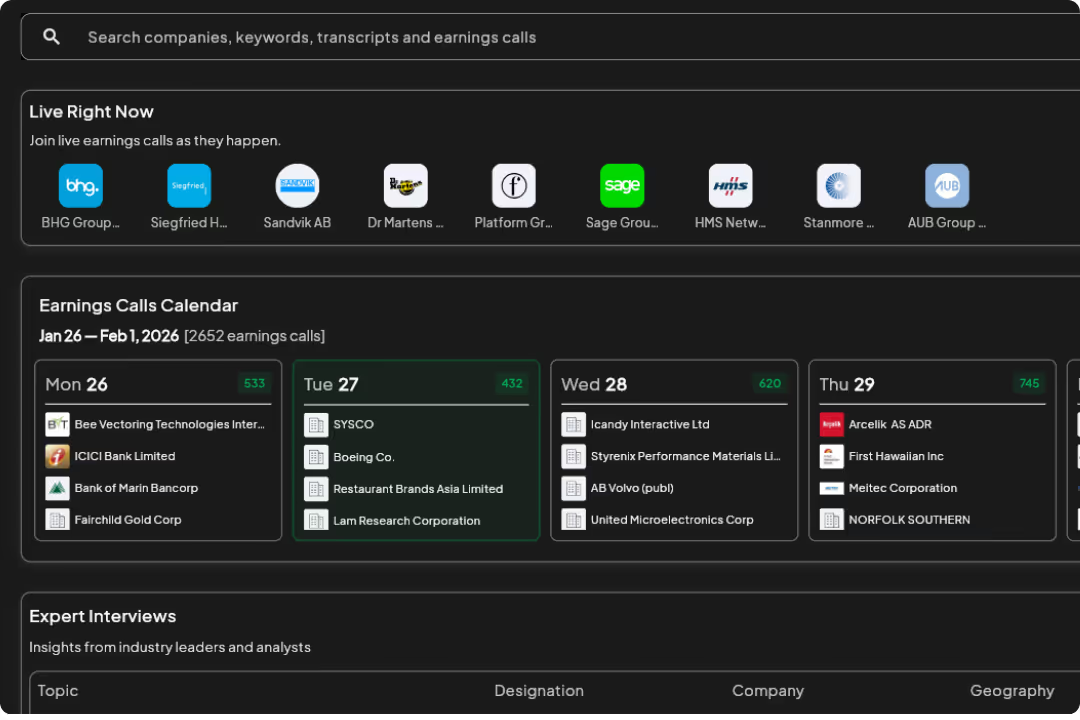
If you use Nextmark’s "Concept Search" to track these initiatives over time, you will often see a pattern of Strategic Amnesia. The CEO stops mentioning "Latin America" in the opening remarks. The "Hardware" division gets folded into "Other Bets."
The market has a short attention span; it forgets the promise. But the silence confirms the failure. If they aren't talking about it, it isn't working.
The "Compound Question" Dodge
The Q&A session is a game of cat and mouse. Analysts know that if they ask one tough question, the CEO might spin it. So, they ask "Compound Questions."
- Analyst: "Three parts for me: 1) How is pricing trending? 2) What is the FX impact? and 3) Why did the CFO leave so abruptly?"
Watch carefully. The CEO will write down all three. They will answer #1 in detail. They will answer #2 with a chart reference. And then... they will say "Next question, please."
They didn't answer #3.
Most investors miss this because they are busy processing the answers to #1 and #2. But the refusal to address #3—the silence—is the loudest signal on the call. It confirms there is a story there they are desperate to avoid.
The Shrinking Q&A
Finally, watch the clock.
A standard earnings call is 60 minutes. Usually, 30 minutes are reserved for Q&A.
If a management team reads a slightly longer prepared statement and cuts the Q&A to 15 minutes, claiming "hard stop" or "schedule conflicts," be on high alert.
Reducing the time for questions is a defensive tactic. It minimizes the surface area for mistakes. It is a statistical attempt to reduce the probability of a "hot mic" moment.
Listen for the Gaps
Humans are wired to process presence. We notice the car honking; we don't notice the quiet street.
To generate Alpha, you have to rewire your brain to process absence.
Don't just read the transcript. Audit it.
- Where is the metric they used to love?
- Where is the update on the project they hyped last January?
- Why didn't he answer the second part of that question?
The signal isn't in the noise. It's in the silence.
Track what went missing.
Nextmark’s "Trend View" allows you to visualize keyword frequency over 5 years. Spot the moment a topic drops to zero.
Ready to see the magic happen? Register for a demo that actually respects your time. Our specialists are standing by to hook you up with platform access or get those API feeds flowing.
Qualitative Data Is the Edge. Start Using It.