
The Death of the Keyword: Why "Concept Search" is the New Edge

There is a habit that every financial analyst learns on their first day on the job.
They open a 20-page transcript. They hit Ctrl+F. They type "Inflation."
If the word appears, they read the sentence. If it doesn't, they assume the topic wasn't discussed.
For decades, this was the industry standard. But in the age of AI and carefully crafted corporate communication, Keyword Search has become a liability.
Why? Because it relies on a dangerous assumption: that the CEO uses the exact same vocabulary as you do.
The reality is that management teams are trained to avoid trigger words. They know that algorithms and analysts are hunting for "Recession," "Delay," and "Risk." So, they don't say those words.
- - They don't say "Recession." They say "macroeconomic softness."
- - They don't say "Price War." They say "strategic pricing actions."
- - They don't say "Supply Chain Failure." They say "logistical recalibration."
If you are searching for keywords, you are searching for a needle in a haystack while wearing a blindfold. You are only finding what you already know to look for.
The new edge in qualitative research is not finding words. It is finding Concepts.
The Problem: The "Synonym Gap"
The limitation of legacy search engines (like the one built into your PDF reader or legacy terminal) is that they are literal. They match characters, not meaning.
This creates the "Synonym Gap."
Imagine you are analyzing a Retail stock, and you want to know if they are struggling to move inventory.
- You search: "Discounting."
- The Result: 0 matches.
- Your Conclusion: Margins are safe.
But three pages later, the CFO said: "We are taking aggressive markdown actions to clear vintage cohorts."
The concept is identical—they are slashing prices. But because they used the word "Markdown" instead of "Discount," your Ctrl+F missed it. Your model is now wrong because your search tool was too dumb to understand the context.
The Solution: Semantic Intelligence
This is where Concept Search (powered by AI) changes the game.
Unlike a keyword engine, a Concept Search engine converts text into mathematical vectors that represent meaning. It understands that "Markdown," "Promotional cadence," and "Price investment" all belong to the same conceptual cluster as "Discounting."
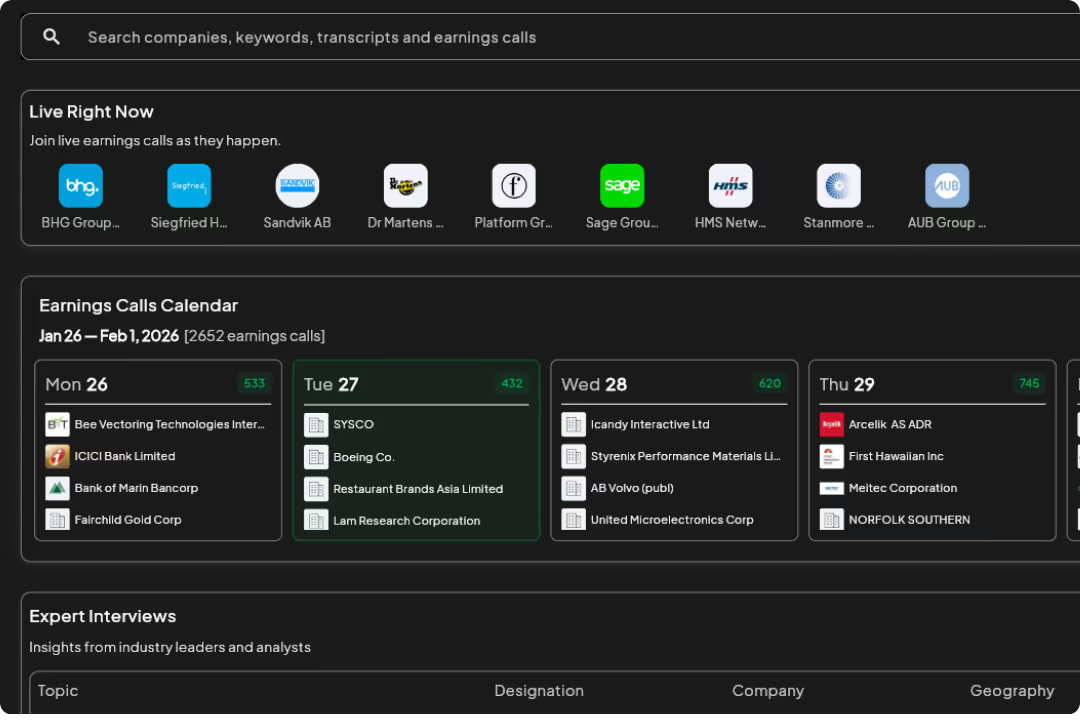
When you use a platform like Nextmark to search for "Rising input costs," the AI doesn't just scan for those three words. It scans for the idea of inflation.
It will surface results like:
- "Raw material headwinds are persisting."
- "Logistics surcharges are impacting gross margin."
- "Vendor pricing power remains elevated."
None of these sentences contain the word "Input" or "Cost." Yet, they are exactly what you needed to see.
Thematic Sweeps: Finding the "Unknown Unknowns"
The true power of Concept Search isn't just reading one transcript better; it's reading the entire market instantly.
We call this the Thematic Sweep.
Instead of analyzing one company, you can ask a conceptual question of the entire S&P 500:
- "Who is worried about AI regulation?"
- "Which Industrial companies are seeing labor hoarding?"
The system will pull every relevant mention—regardless of whether the CEO said "Regulation," "Legislation," "Washington," or "Compliance."
This allows you to spot Cluster Risks—themes that are bubbling up across a sector before they hit the headlines. If 40% of the semiconductor supply chain starts using language related to "inventory digestion" (a polite word for "nobody is buying"), you can short the sector before the revenue miss becomes official.
Stop Searching. Start Understanding.
In a world where information is infinite, the ability to filter is the only competitive advantage.
Keyword search filters by character matches. It is a blunt instrument for a nuanced world.
Concept search filters by intent. It matches the way humans actually think.
Don't let your thesis die because you didn't guess the right synonym. Stop using Ctrl+F. Start using intelligence.
Find what they mean, not just what they say.
Nextmark’s Concept Search engine is trained on 15 years of financial discourse.
Ready to see the magic happen? Register for a demo that actually respects your time. Our specialists are standing by to hook you up with platform access or get those API feeds flowing.
Qualitative Data Is the Edge. Start Using It.