
The 15-Year Archive: Why Historical Context Wins Trades
Wall Street has a memory problem.
The average tenure of a sell-side analyst is often shorter than the business cycle of the companies they cover. The average holding period for a stock has collapsed to under 6 months. In this environment of hyper-short-termism, the market suffers from Institutional Amnesia.
We obsess over the guidance for next quarter, but we rarely ask: "What did this CEO promise five years ago, and did they actually deliver?"
This lack of historical context is a massive inefficiency. Management teams know that if they can just survive the news cycle, the market will forget their failed initiatives.
But the data remembers.
To generate "Through-Cycle" Alpha, you cannot just look at the last 12 months of transcripts. You need to look at the last 15 years. Here is why the "Deep Archive" is the most underrated tool in your arsenal.
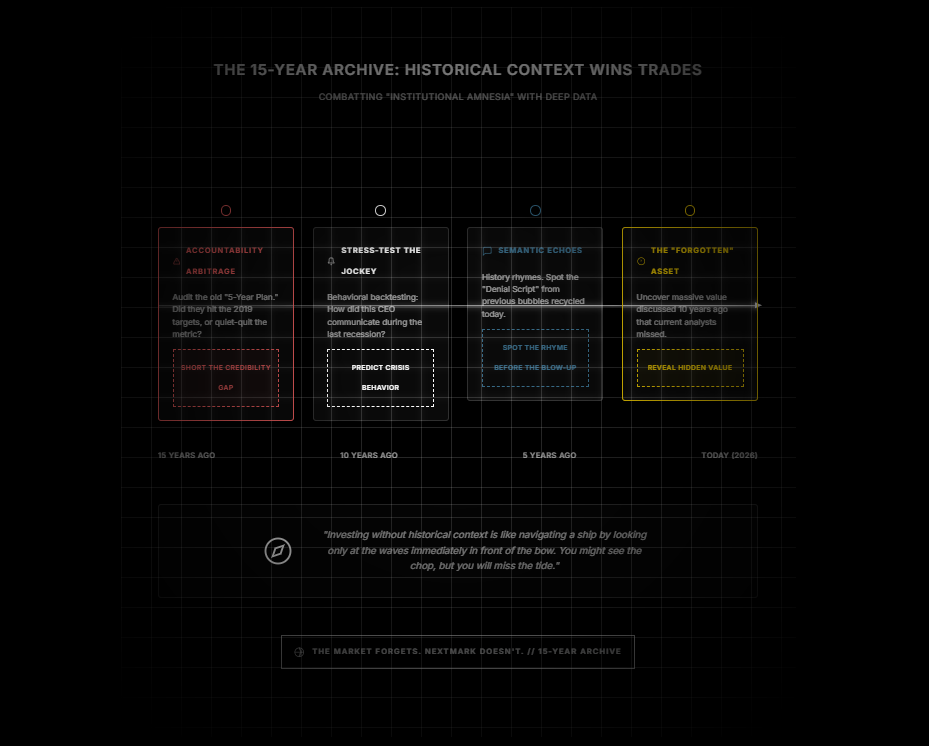
The "Accountability" Arbitrage
Every CEO has a "5-Year Strategic Plan." They announce it with fanfare, bold slides, and aggressive targets.
Three years later, the market has usually forgotten the specific targets. But the transcript archive hasn't.
The Strategy: Before you buy a stock based on a new promise, audit the old ones.
- Search: Go back to the 2019 transcripts.
- Verify: They promised 15% CAGR in the APAC region.
- Check: Did they hit it? Or did they quietly stop reporting "APAC" as a standalone segment in 2021 to hide the failure?
If a management team has a history of "Goal-Post Moving"—changing metrics when the old ones turn sour—you can be certain the new 5-Year Plan is equally worthless. You can short the credibility gap.
Stress-Testing the Jockey
It is easy to be a good CEO in a bull market. The true test of management quality is how they handle a crisis.
Most datasets today only cover the post-COVID boom. They don't show you how the current leadership team navigated a real liquidity crunch or a high-rate environment.
With a 15-year archive, you can perform Behavioral Backtesting.
- How did this bank's CEO communicate during the 2008 GFC?
- How did this Industrial CFO manage cash flow during the 2015 manufacturing recession?
Did they panic? Did they dilute shareholders at the bottom? Or did they buy back stock aggressively?
Past behavior is the best predictor of future behavior. If you aren't reading the transcripts from the last crisis, you are flying blind into the next one.
Semantic Echoes: When History Rhymes
Mark Twain famously said, "History doesn't repeat itself, but it rhymes." In financial markets, it often uses the exact same words.
We often see Semantic Echoes—specific clusters of phrases that appear right before a sector blow-up.
- In 2007, housing CEOs talked about "Subprime containment" and "Credit normalization."
- In 2021, tech CEOs talked about "New paradigms" and "Permanent shifts."
By searching the deep archive for these linguistic patterns, you can spot when a management team is recycling the "Denial Script" from a previous bubble.
If the CEO of a levered REIT starts using the exact same "defensive" language that their predecessor used in 2008, the alarm bells should ring. The market might not remember the rhyme, but the AI does.
The "Forgotten" Asset
Finally, history often hides value.
Sometimes, a company owns a massive asset (a patent portfolio, a land bank, a minority stake) that was discussed heavily 10 years ago but hasn't been mentioned in the last 20 earnings calls. The current crop of analysts, who have only covered the stock for 2 years, might not even know it exists.
A deep search for "non-core assets" across 15 years of transcripts can reveal hidden value that isn't on the front page of the 10-K.
Don't Trade Without a Map
Investing without historical context is like navigating a ship by looking only at the waves immediately in front of the bow. You might see the chop, but you will miss the tide.
The next time a CEO sells you a vision of the future, take a moment to read their past. The truth is usually hidden in the archives.
The market forgets. Nextmark doesn't.
Access 15+ years of full-text transcripts, searchable by concept, across thousands of global companies.
Ready to see the magic happen? Register for a demo that actually respects your time. Our specialists are standing by to hook you up with platform access or get those API feeds flowing.
Qualitative Data Is the Edge. Start Using It.