
Earnings Season Survival Guide: Are You Listening or Just Modeling?
The ritual is the same every quarter. The bell rings, the press release hits the wire, and the race begins.
For the next three weeks, analysts across Wall Street will frantically copy-paste numbers from a PDF into an Excel spreadsheet. They will update revenue actuals, tweak margin assumptions, and re-calculate EPS to the third decimal point.
This is the "Modeling" approach. It is rigorous, it is necessary, and it is largely a waste of time if your goal is generating Alpha.
Why? Because by the time you hit "Save" on that spreadsheet, a thousand algorithms have already priced in those numbers. The efficiency of quantitative data is absolute. If it fits in a cell, it is already in the price.
The edge in this earnings season—and every season moving forward—is not in the math; it is in the listening.
While the consensus is focused on what the management team reported, the smart money is focused on how they reported it. Here is how to survive—and profit from—the noise of earnings season by shifting your workflow from "Data Entry" to "Signal Detection."
The "Model Blindness" Trap
The danger of an Excel-centric workflow is that it gives you a false sense of precision. You see a revenue beat of 3% and assume the company is healthy.
But the model cannot capture the sigh the CFO gave before answering a question about free cash flow. It cannot capture the fact that the CEO stopped using the phrase "secular growth" and started using "cyclical resilience."
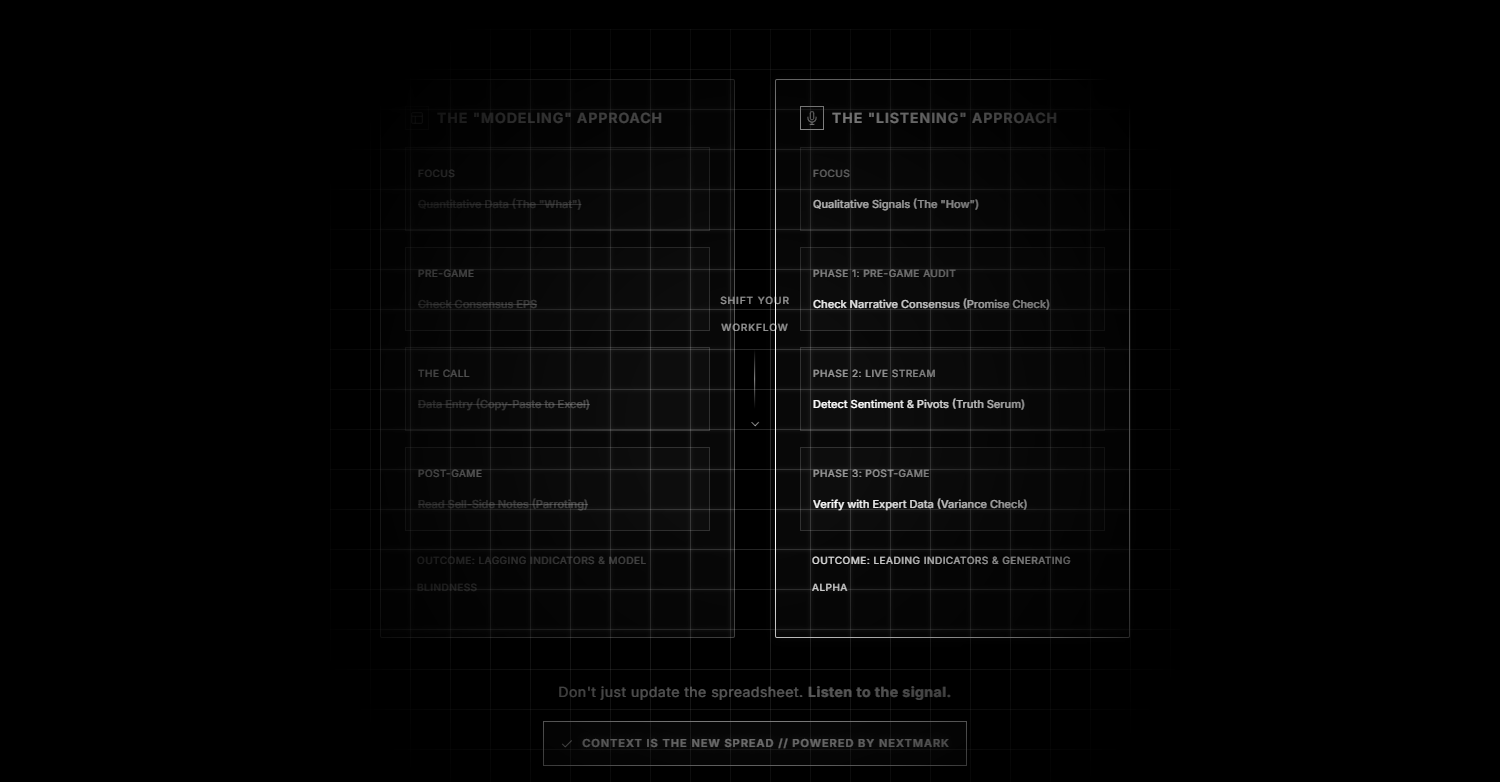
These are Qualitative Signals. They are the leading indicators of future performance, whereas your model is merely a lagging indicator of past execution. To capture them, you need a "Listening Workflow."
Here is the 3-step protocol for the modern qualitative investor.
Phase 1: The Pre-Game Audit (The "Promise Check")
Most analysts prepare for a call by looking at Consensus Estimates. What does the Street expect for EPS?
Instead, you should look at Narrative Consensus. What did the CEO promise?
Before the call starts, use a semantic search tool (like Nextmark) to scan the transcripts from 6 and 12 months ago. Isolate the specific promises made about strategic initiatives.
- - Did they promise a margin inflection by Q3?
- - Did they claim the supply chain issues were "transitory"?
Create a "Listening List" of these specific topics. If management avoids these keywords in their opening remarks, that silence is a data point. In qualitative analysis, omission is often louder than admission.
Phase 2: The Live Stream (The "Truth Serum")
The Prepared Remarks section of an earnings call is a marketing event. It is written by Investor Relations and scrubbed by Legal. It is "Safe Harbor" theater.
The real call begins at the Q&A.
This is where the mask slips. A CEO can memorize a script, but they cannot script their physiological reaction to a tough question about demand headwinds.
Watch the Sentiment Score:
Don't just listen to the answer; measure the conviction.
- The "Pivot": If an analyst asks a direct "Yes/No" question (e.g., "Are booking rates holding up?"), and the CEO responds with a paragraph about "long-term value," that is a negative signal—even if the words sound positive.
- The Divergence: If the sentiment score for the Presentation was Positive (+0.6) but the sentiment score for the Q&A drops to Neutral/Negative (-0.1), the management team is defensive. The "Beat" on the top line matters less than the fear on the bottom line.
Phase 3: The Post-Game (The "Variance" Check)
Once the call is over, the sell-side notes will flood your inbox. They will largely parrot what management just said.
This is your opportunity to verify reality.
Take the core claim of the earnings call—for example, "Inventory levels are healthy."—and immediately cross-reference it with Primary Expert Data.
Search your expert transcript library for "Inventory" + "[Company Name]" from the last 30 days.
- - What are the regional distributors saying?
- - What are the former supply chain managers saying?
If the CEO says "Healthy" and the Expert Network says "Stuffed," you have found the Variance. This is where Alpha lives. The market is pricing in the CEO's optimism; you can price in the channel's reality.
Conclusion: Context is the New Spread
We are not suggesting you throw away your models. Quantitative rigor is the foundation of investing.
But in an age of commoditized data, the model is table stakes. The differentiator is Context.
This earnings season, don't just ask "Did they beat the number?" Ask "Did they change the story?" Don't just update the spreadsheet. Listen to the signal.
Ready to listen?
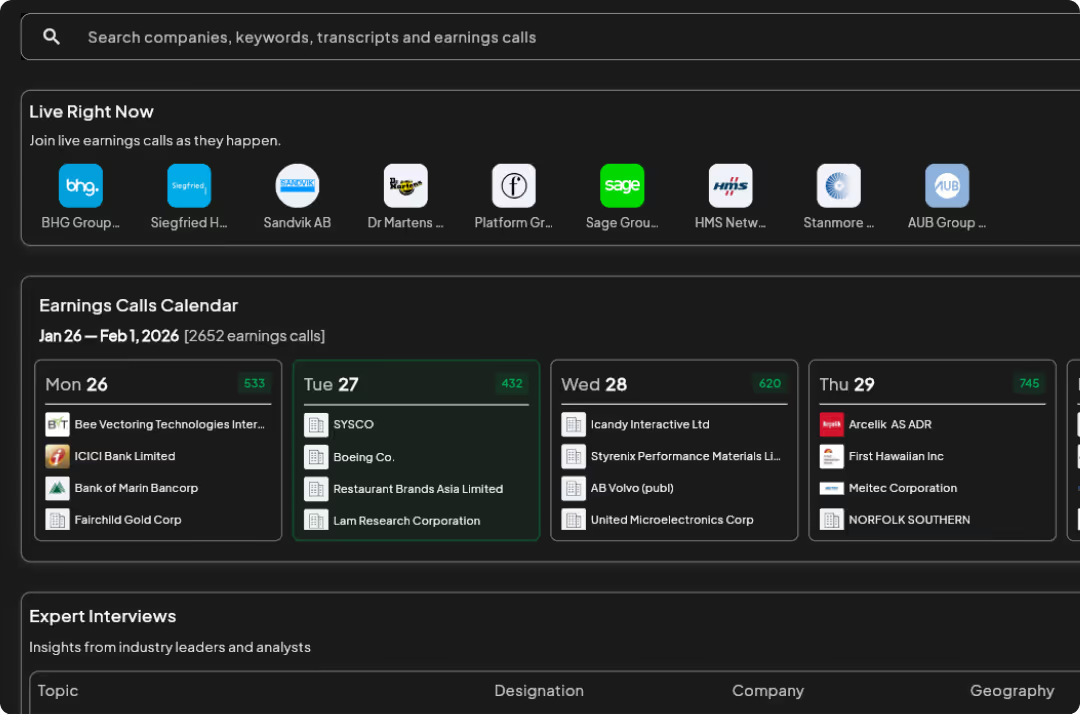
Nextmark is a platform that combines live earnings sentiment, 15 years of historical transcripts, and a library of primary expert insights in one place.
Ready to see the magic happen? Register for a demo that actually respects your time. Our specialists are standing by to hook you up with platform access or get those API feeds flowing.
Qualitative Data Is the Edge. Start Using It.